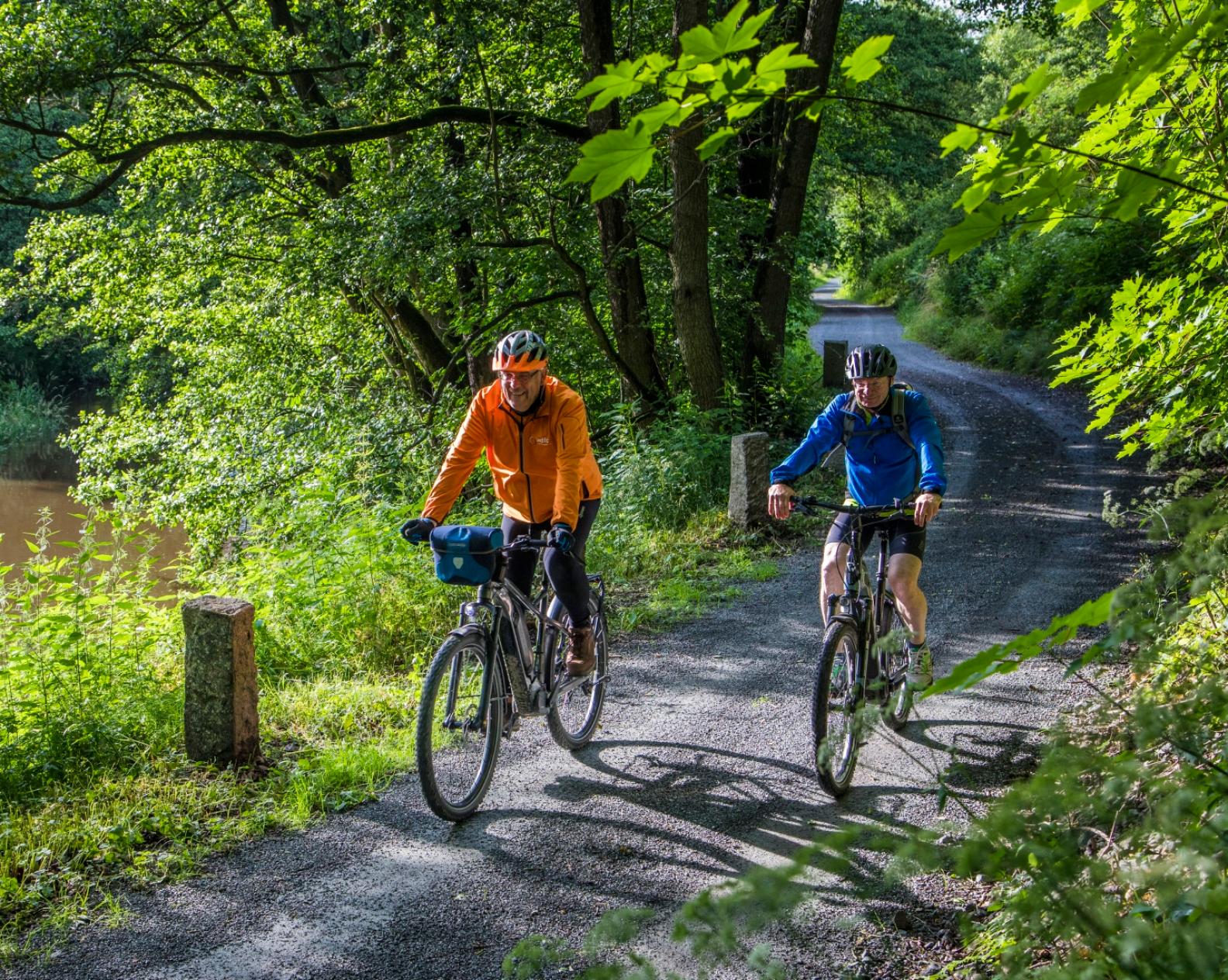
Bikepacking is family-friendly. Especially on Upper Bavaria’s Wasser-Radlwege (waterside cycling routes), which link cultural and natural highlights with some of the region’s most beautiful river and lake landscapes. A four-day micro-adventure between Holzkirchen and Murnau
Cycling Along the Water in Upper Bavaria: A Personal Test with Kids
Tent, sleeping bag, sleeping mat, gas stove, cooking pot set, pocket knife, bowl and plate, rain jacket, warm jacket, short- and long-sleeved tops, sandals, cycling shorts, bike pump, puncture repair kit, helmet, first-aid kit, water bottles, snacks …
The packing list keeps growing, but the two 25-litre bike panniers stubbornly refuse to get any bigger. My friend Kathrin and I are messaging each other almost every minute, discussing who packs what and in which form. How cold will it get at night in the tent – do we take a lightweight or a warmer sleeping bag? Are two spare shirts enough for the two boys? Should a thick pair of tights still go into the bags?
While I stuff and stack until every cubic centimetre of the panniers is filled, I can’t stop thinking about the weight I’ll have to move using nothing but muscle power.

Bikepacking with Kids
The plan is a four-day bikepacking tour along the waterside cycling routes. Together, these routes cover a total of 1,200 kilometres in three loops across Upper Bavaria. Each loop is around 300 kilometres long, well signposted, and runs between the Alps and the Danube. Each one focuses on a different theme: hops in the north, salt in the south-east, and art in the south-west.
The main starting point is Munich, but thanks to good rail connections in many towns, the routes can be adapted and combined in countless ways. Whichever route you choose, water experiences along Upper Bavaria’s rivers and lakes are always part of the journey – perfect for refreshing cycling fun with the whole family.
A Guaranteed Workout: 45 kg Towing Load
For our bikepacking adventure with two children, we chose Holzkirchen as our starting point. In the Bavarian Alpine foothills, the “Art Loop” involves significantly more climbs than the “Hop Loop” north of Munich.
I start breaking a sweat just thinking about it: the bike trailer carrying both children weighs around 45 kilograms, plus the panniers. Thankfully, three-year-old David already cycles short sections on his own.
His mum, Kathrin Redl, has converted an old child trailer into a cargo trailer and placed a waterproof bag with her gear on top. When David takes a break in the trailer, she straps his bike on top.
We are a well-practised team. It’s not our first trip together. Last year, we cycled more than 600 kilometres from Geneva to the Mediterranean. Still, every tour requires individual planning – and depending on the children’s age, a different set-up.

Planning? What Planning?
Speaking of planning: this time, admittedly, it fell a bit short. We set no daily stages, booked no accommodation, and didn’t even decide on a final destination. With children, it’s difficult to plan exact distances, as motivation and weather can change everything from one day to the next. We also don’t want to book accommodation in advance – if the weather is miserable, there’s no point setting off at all.
So, after a quick weather check, we decide spontaneously to leave on a Thursday at the end of July. Right in peak season! A bad idea? That’s what we ask ourselves when we stop for a break at Lake Tegernsee on the evening of our first day of cycling. The children splash happily in the shallow water along the lakeside promenade in Gmund, while the mums make sandwiches. “Should we put up our tent here?” asks Nelion. Right by the water, with views of the Alpine foothills, the pebbled shore would be the perfect spot. But wild camping, as everyone knows, is not allowed.


Just two hours until sunset. And we still don’t know where we’re going! There is a campsite on the Oedberg hill above the lake, but no one answers the phone, and we don’t want to cycle that far uphill in the wrong direction without knowing whether we can actually stay.
So we continue cycling uphill along the western shore to the small village of Holz. Scattered farmhouses lie idyllically between woods and meadows on the hillside. A farmer is working on his pasture fence. We greet him politely and ask whether we could pitch our tents on his meadow. “Yes, no problem at all,” he says in Bavarian dialect, pointing to a spot next to a barn. “Tomorrow morning it’ll get a bit noisy – I’ll be bringing the cows out to the meadow,” he adds, almost apologetically. It’s not a solution we’d recommend, but today we can’t go any further.
The children pet the farm dog, pluck grass for the cows and help put up the tents. We still manage to cook a lentil curry, then, completely exhausted, we snuggle into our sleeping bags at around half past ten.
Close to the Water: Isar Cycle Path
Thunder rumbling and heavy rain pounding down wake us early. The morning is quite literally washed out. Luckily, the boys have their waterproof mud trousers with them – otherwise they would be soaked through after playing on the meadow alone.
We cycle the first stage over cobblestones up to the hamlet of Marienstein while it’s still dry. After that, even waterproof trousers are no help anymore. In thunderstorms and heavy rain, we pedal on towards Bad Tölz. The boys play with toy cars in the trailer and tell each other funny stories. We are soaked to the skin. My aunt Helga in Bad Tölz saves the day: she invites us in for Kässpätzle (cheese noodles) and hot tea. She puts our wet clothes straight into the tumble dryer.
Later, we cycle through the historic market street of Bad Tölz, passing Baroque houses richly decorated with Lüftlmalerei (traditional painted façades). Then we continue south on gravel paths along the Isar. The Upper Isar Valley stretches from the river’s source in the Karwendel mountains to Munich and, with its river branches, gravel banks and floodplain forests, forms one of Bavaria’s last wild river landscapes.

In Lenggries, we leave the Isar and battle up the final steep metres to Bergcamping Lenggries, at the foot of the Brauneck mountain, the local mountain of Lenggries. The children take a siesta in the trailer. We take advantage of the moment and lie down right next to them.
Later, we stroll over to the campsite reception. “You don’t have a reservation?” the receptionist asks in disbelief and is already about to turn us away. But then she does manage to find a small spot on the fully booked camping meadow. Lucky us!
With an inn, bike storage, washing machines and luxurious sanitary facilities, the campsite is very well equipped. When the rain starts again, we move into the common room with our gas stove and pot of spaghetti.


Swimming fun in the Bavarian Caribbean
“You have to wear a helmet, you silly goose!”- David (3) -
The next morning, it takes a little longer to pack away the wet tent, spoon down the muesli and get the children dressed. Full of motivation, David hops onto his tiny bike and offers passing cyclists wise advice: “You have to wear a helmet, you silly goose!”
Just south of Lenggries, we turn off towards Lake Walchensee. We follow the Jachen river through a wild floodplain landscape of birch trees, heather and juniper. On a gravel bank along the Jachen, we stop for a swim and a Brotzeit (snack break). Then we continue along a small state road through the quiet high valley, with the mountains closing in ever closer on both sides. The villages of the Jachenau valley form a picture-book Upper Bavarian idyll, with the so called Lüftlmalerei (facade paintings) and lush geraniums beneath the windows of large farmhouses.
With burning calves, I haul the heavy child trailer up the steep toll road. E-bike riders and motorcyclists whizz past. A grey-bearded man standing by the roadside cheers us on: “You’re heroes!” On the fast descent, the children cheer with delight in the trailer.

The effort is worth it: Lake Walchensee – sometimes called the “Bavarian Caribbean” – welcomes us with turquoise-blue water. Like a shimmering blue jewel, the deep mountain lake lies in the Bavarian Alpine foothills. On beautiful summer days like this one, it’s extremely busy. Cars, cyclists and pedestrians jostle for space along the narrow road on the southern shore. We take a long break to swim – our second of the day.
A look at the Camping Walchensee website is sobering: “We are fully booked until mid-September,” it says in bold red letters. As the last rays of sunlight illuminate the impressive peaks of the Wetterstein and Karwendel mountains, we cycle on to Krün, where a friend has offered us refuge in her garden.

Between the Zugspitze Mountain and Lake Staffelsee
On the final day of our cycling adventure, we really find our flow. Against a stunning mountain backdrop of the Zugspitze mountain, the Wetterstein range and the Karwendel mountains, we cycle from Krün past Lake Barmsee to Lake Geroldsee. The small moor lake tempts us into a refreshing dip even before midday. We continue through the Werdenfelser Land region with its protected hummocky meadow. Via the historic Ludwigstraße, we ride into Partenkirchen, the eastern half of the twin town of Garmisch-Partenkirchen. This former Roman trade route already connected Augsburg with Venice more than 2,000 years ago.
“Today we can only do a bit more cycling – I need to save my energy for tomorrow.”
Anyone interested in nature should visit the spectacular Partnach Gorge. Unfortunately, time is running out, so all we manage is an ice cream in the sun. “Today we can only do a bit more cycling – I need to save my energy for tomorrow,” says David, before his eyes close in the trailer. On an idyllic cycle path, we cross the Kuhflucht Nature and Recreation Park.
We miss the Kuhflucht waterfalls near Farchant – which plunge down 270 metres in three cascades – because the children are asleep. Instead, we enjoy the ride through the unique landscape of the Murnauer Moos peatland. Covering 4,200 hectares, it is one of the largest continuous moorland areas in Central Europe.


On the steep approach into Murnau, we work up a sweat once more, then roll downhill to the lido on Lake Staffelsee. Once again, we cycle right down to the water and would love to stay another night – but surprise! The "Halbinsel Burg campsite" is fully booked. So after our early-evening swim, we squeeze ourselves and our bikes onto the crowded regional train back to Munich.